How to Leverage Piezo Technology for Efficient Manufacturing?
In today’s fast-paced manufacturing world, the integration of Piezo Technology is changing the game. Experts believe this technology can significantly improve efficiency. Dr. Emily Carter, a leading authority in the field, once stated, "Piezo Technology can reshape how we think about precision in manufacturing." This perspective highlights the immense potential Piezo Technology holds.
Manufacturers are now exploring how these piezoelectric materials can enhance their processes. The precise control over motion and force is particularly valuable. Factories can achieve higher efficiency and reduce waste through accurate movements. However, the transition to incorporating these technologies is not without its challenges. Companies must evaluate their current systems and consider the required adaptations.
While the benefits are evident, not many fully understand Piezo Technology's applications. This gap often leads to underutilization of its advantages. Manufacturers must engage in continuous learning to leverage this technology effectively. The journey to mastering Piezo Technology requires commitment and reflection, yet the rewards can be substantial for the manufacturing sector.
Leveraging Piezo Technology: Understanding the Fundamentals of Piezoelectricity
Piezoelectricity is a fascinating phenomenon that converts mechanical stress into electrical energy. This principle is crucial for various applications in modern manufacturing. Understanding piezo technology can significantly enhance efficiency in production processes. The technology relies on materials that generate voltage when deformed. These materials are often compact and lightweight, making them ideal for integrated systems.
In manufacturing, piezoelectric actuators and sensors improve precision. They allow for real-time adjustments during production. For example, when a piezo actuator changes shape, it can create movement in machinery. This fine control can reduce waste and increase output. However, not all piezo materials perform equally. Some may fail under extreme conditions. Balancing the choice of materials with operational demands is essential.
Implementing piezo technology requires a thoughtful approach. Companies need to invest time in testing and development. There may be initial hurdles in adapting existing machinery. Understanding the nuances of piezo applications can lead to better decision-making. It’s also important to stay updated on advancements in this field. Continuous learning helps in maximizing the benefits of piezo technology.
How to Leverage Piezo Technology for Efficient Manufacturing?
| Application |
Benefits |
Challenges |
Potential Solutions |
| Automotive Sensors |
Enhanced accuracy, durability |
High production costs |
Invest in R&D for cost reduction |
| Industrial Machinery |
Improved efficiency, reduced maintenance |
Complex integration processes |
Develop modular systems |
| Medical Devices |
Non-invasive, precise measurements |
Regulatory hurdles |
Collaborate with regulatory bodies |
| Consumer Electronics |
Compact and lightweight designs |
Market competition |
Focus on innovative features |
| Aerospace Applications |
Enhanced safety, reduced weight |
High safety standards |
Thorough testing and validation |
Key Applications of Piezo Technology in Modern Manufacturing Processes
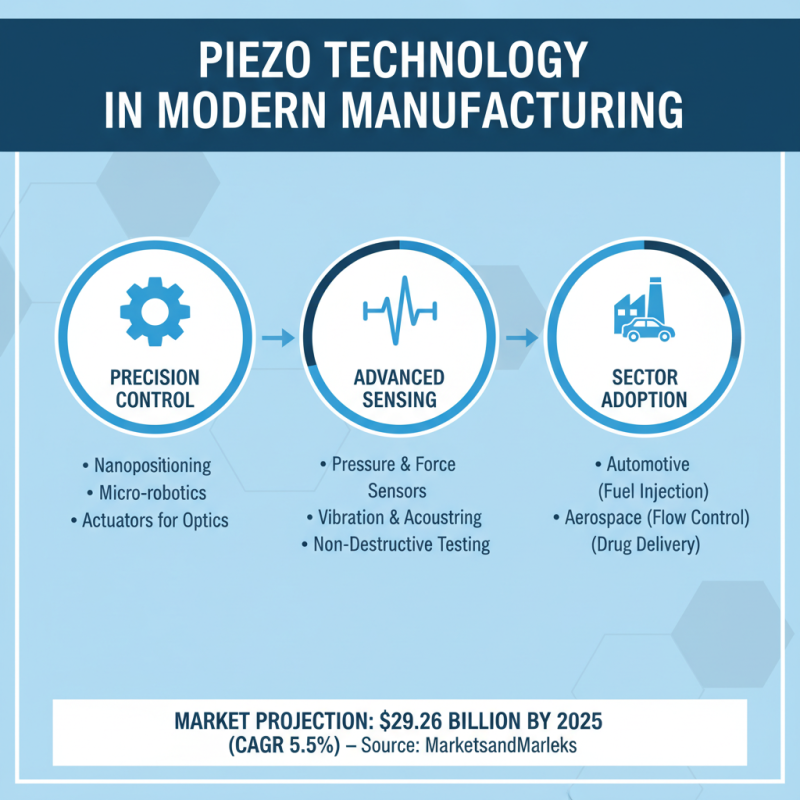
Piezo technology has become integral to modern manufacturing processes. Its applications range from precision motion control to advanced sensing capabilities. According to a report by MarketsandMarkets, the piezoelectric device market is projected to reach USD 29.26 billion by 2025, growing at a CAGR of 5.5%. This indicates a significant shift towards piezo technology in sectors like automotive and aerospace.
In robotic automation, piezo actuators enhance efficiency and precision. They allow for rapid movements and better positional accuracy, essential in delicate assembly tasks. For instance, in semiconductor manufacturing, piezoelectric devices facilitate cleanroom operations. They provide precise control over environmental conditions, ensuring optimal product quality. Despite these advantages, manufacturers must consider challenges such as the high cost of piezo materials and potential integration difficulties with existing systems.
Additionally, piezo technology's role in sensors provides real-time monitoring. This capability leads to improved decision-making and proactive maintenance. However, the reliability of these sensors can sometimes falter due to environmental factors. Companies must invest in research to enhance sensor durability. Proper understanding and application of piezo technology can transform manufacturing, but it requires careful consideration and strategic planning.
Analyzing the Cost-Benefit Ratio of Implementing Piezo Systems in Production
The integration of piezo technology into manufacturing processes can significantly improve efficiency. The cost-benefit ratio of implementing piezo systems should be carefully analyzed. While initial investments may seem high, the long-term gains are substantial. They ensure precise actuations, reduce waste, and increase production speed.
Investments in piezo systems lead to lower operational costs. For example, they enhance the lifespan of machinery. This results in fewer maintenance needs and minimized downtime. However, companies should conduct thorough cost analyses. Assessing long-term operational savings against upfront costs is essential.
**Tips:** Always consider how piezo technology will fit into your existing processes. Evaluate not just the purchase costs, but also the expected efficiency gains. Collaborate with experts to analyze potential ROI accurately. Embrace flexibility in your implementation plan, as every manufacturing environment is different. Continuous reflection on your system's performance is vital.
Case Studies: Successful Integration of Piezo Solutions in Industry
Piezo technology has proven its value in various industrial applications. For instance, a leading automotive manufacturer implemented piezoelectric actuators in their assembly lines. The result was a notable increase in precision during the machine assembly process. This integration allowed for tighter tolerances and faster production rates. However, the transition was not without challenges. Workers required retraining to manage the new systems effectively.
Another compelling case involves the aerospace sector. Here, piezoelectric sensors enhanced monitoring capabilities for critical components. This integration provided real-time data that improved decision-making processes. Companies reported fewer maintenance issues and extended equipment lifespans. However, these benefits came with initial implementation hurdles. Data interpretation skills were necessary, and some teams struggled to adapt, highlighting areas for improvement.
In the field of consumer electronics, piezo technology is being utilized for better sound quality in speakers. Manufacturers who adopted these solutions faced issues related to heat dissipation. Piezo components are sensitive to temperature changes, affecting performance. Addressing these concerns required innovative cooling designs and rigorous testing. These case studies illustrate the nuanced journey of integrating piezo solutions into manufacturing, demonstrating both the potential and pitfalls of this advanced technology.
Future Trends: Innovations in Piezo Technology Shaping Manufacturing Efficiency
Piezo technology is revolutionizing the manufacturing sector, and its future trends promise enhanced efficiencies. Recent innovations harness the unique properties of piezoelectric materials to convert mechanical stress into electric energy. This capability can streamline many processes, such as precision control in assembly lines. It allows for more responsive machinery that adapts to real-time conditions.
The integration of smart sensors powered by piezo technology is becoming increasingly common. These sensors provide instant feedback, making manufacturing processes more adaptable and efficient. For example, they can monitor machinery health, reducing downtime. However, challenges remain in the widespread adoption of piezo solutions. The cost of implementation and the necessity for skilled personnel can hinder progress.
Further explorations into miniaturization and energy harvesting are underway. Smaller piezo devices could lead to more compact machinery. Energy harvesting applications can also reduce operational costs. Yet, the path forward must address scalability and the durability of materials. As these innovations unfold, they highlight the importance of continual research and development in the realm of piezo technology.
How to Leverage Piezo Technology for Efficient Manufacturing
This chart illustrates the efficiency gains in manufacturing through the adoption of piezo technology over different sectors including Automotive, Aerospace, Consumer Electronics, and Medical Devices.