Top 5 Tips for Choosing the Best Active Piezo Buzzer?
Choosing the right active piezo buzzer can significantly impact your project. This small yet powerful component is crucial in many electronic designs. Understanding its features helps ensure optimal performance.
Active piezo buzzers convert electrical signals into sound. They are simple to use and require less space. However, selecting the best one isn’t always straightforward. Different applications demand different specifications. Noise level and frequency response are essential factors to consider.
Not all buzzers meet the same standards. Some may offer impressive loudness but produce harsh sounds. Others might have a pleasant tone but lack volume. An ideal buzzer strikes a balance. Knowing your needs will guide your choice. Careful evaluation of each option is important. It’s also wise to read reviews to gauge reliability.
Understanding the Functionality of Active Piezo Buzzers in Applications
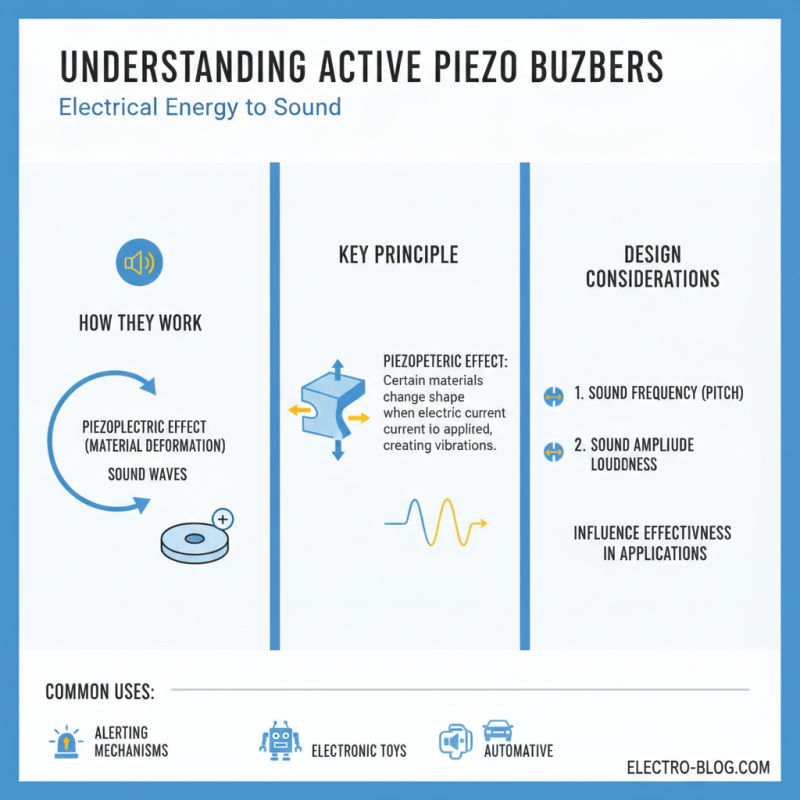
Active piezo buzzers are commonly used in various applications, from alerting mechanisms to electronic toys. They work by converting electrical energy into sound. This process is driven by the piezoelectric effect, where materials deform in response to an electric current. Understanding this functionality is crucial. Design choices often depend on sound frequency and amplitude, which directly influence the buzzer's effectiveness.
When integrating an active piezo buzzer into your project, consider the intended use. Will it be for signaling an alert or providing feedback? The sound's clarity and volume play a significant role. Buzzers can typically produce audible ranges between 2 kHz to 4 kHz. Ensure that this range corresponds with your application’s requirements.
It’s essential to think about environmental factors. Your buzzer might face moisture or temperature extremes. Piezo buzzers can be sensitive. They may degrade faster in adverse conditions, impacting longevity. Testing under actual operating conditions can provide insight. This reflection can lead to better designs and longer-lasting solutions, enhancing reliability in your projects.
Key Specifications to Consider When Selecting Active Piezo Buzzers
When selecting active piezo buzzers, certain specifications are crucial. The
sound frequency is one of the most important features. Most buzzers operate between
2 kHz to 4 kHz, which is suitable for many applications. However, understanding
the frequency range for your specific use is vital. A mismatch can lead to unwanted noise or insufficient sound.
Another key factor is power consumption. Many active piezo buzzers consume low power,
typically around 5-20 mA. This makes them ideal for battery-operated devices. It’s essential
to review the current draw to ensure it fits within your device's power budget. High power consumption could lead to shortened
battery life, impacting product reliability.
The operating temperature range is also critical. Some buzzers can operate effectively
from -20°C to 70°C. Testing your buzzer in the specific environmental conditions where
it will be used is advisable. There's a risk of performance issues if these conditions are not considered. Ensuring that your
piezo buzzer meets the demands of your application will prevent failures.
Evaluating Sound Pressure Level and Frequency Response in Buzzers
When selecting an active piezo buzzer, evaluating sound pressure level (SPL) and frequency response is essential. SPL is measured in decibels (dB) and indicates how loud the buzzer can be. Research suggests a typical SPL for effective buzzers hovers around 70 dB at 1 meter. This level can adequately signal users in noisy environments. However, some applications may require higher SPL, pushing the limit to 90 dB or more. Before making a choice, consider your intended use and environment.
Frequency response is equally critical. This defines the range of frequencies that the buzzer can produce, often specified in hertz (Hz). Many standard buzzers operate efficiently between 2 kHz and 4 kHz. In contrast, specialized applications might demand wider frequency ranges. However, choices with more extensive ranges can compromise sound clarity. Investigating graphs that illustrate frequency response curves can provide insights. These curves elucidate how the buzzer performs at different frequencies, allowing you to make an informed decision.
Choosing the right piezo buzzer involves balancing SPL and frequency response. An SPL that is too low may go unnoticed in specific settings. Yet, choosing one with excessive power could lead to ear fatigue or damage. A thorough evaluation of these factors, supported by data and analysis, helps ensure that your selection meets both performance and user comfort.
Comparing Different Types of Active Piezo Buzzers and Their Use Cases
When choosing an active piezo buzzer, understanding the types available is critical. There are two main categories: continuous and intermittent buzzers. Continuous buzzers produce a steady sound, while intermittent ones create bursts of sound. This distinction matters greatly in applications. For example, if a consistent alert is required, a continuous buzzer may suit the purpose better.
Different use cases dictate the kind of buzzer to select. In an alarm system, a loud, continuous buzzer can alert individuals effectively. Alternatively, a softer intermittent beep might be ideal for a notification system in a quiet environment. It's essential to consider the volume and frequency as well. Some buzzers can be quite loud, which may not be appropriate for all settings. Additionally, the pitch can influence how well the sound carries.
The size and power requirements of the buzzer can also pose challenges. Smaller devices may require specific power levels to function properly. This can complicate designs where space and energy efficiency are priorities. Reflecting on these factors can lead to better choices. Choices that align with system needs can ultimately enhance the user experience.
Top 5 Tips for Choosing the Best Active Piezo Buzzer
| Tip Number |
Tip Description |
Use Case |
Sound Level (dB) |
Operating Voltage (V) |
| 1 |
Consider the frequency and pitch |
Alarm systems |
85 |
5-12 |
| 2 |
Evaluate power consumption |
Portable devices |
80 |
3-5 |
| 3 |
Check for environmental protection |
Outdoor applications |
90 |
12-24 |
| 4 |
Select suitable mounting type |
Embedded systems |
75 |
5-15 |
| 5 |
Review the size and weight constraints |
Wearable technology |
78 |
1.5-3 |
Assessing Reliability and Lifespan of Active Piezo Buzzers in Design Choices
When selecting a piezo buzzer, reliability and lifespan should be key considerations. Active piezo buzzers are often chosen for their efficiency. However, not all buzzers perform equally over time. Materials used in construction greatly influence durability. Quality components can lead to longer product lifespans. Always assess manufacturing processes for any red flags.
It's vital to test the buzzers in your specific application. Subjecting them to real-world conditions can reveal weaknesses. High-frequency operations may strain some models. A buzzer that works well in one environment might fail in another. Keep this in mind when conducting evaluations.
Regular testing helps in understanding a buzzer's lifecycle. Some buzzers may degrade faster than expected. Monitoring performance over time ensures you choose the most reliable option. Don't underestimate the importance of thorough assessments. Making an informed decision is crucial for long-term success.