Why is Piezo Motion Revolutionizing Precision Technologies?
The advancements in technology are often marked by breakthrough innovations. One such innovation is Piezo Motion. This remarkable technology leverages the unique properties of piezoelectric materials. These materials can convert electrical energy into precise mechanical motion. This capability is transforming precision applications across various industries.
In the realm of robotics and automation, Piezo Motion is making waves. It offers high accuracy and speed that traditional methods struggle to achieve. For instance, in medical devices, the need for precision is paramount. Piezo Motion enables incredible accuracy in surgical tools, enhancing patient safety and outcomes.
However, integrating Piezo Motion into existing systems is not without challenges. Engineers must navigate complex control systems and materials science. The learning curve can be steep, leading to potential setbacks. Yet, embracing these challenges can lead to groundbreaking solutions that redefine precision technology. The journey of Piezo Motion is still unfolding, promising a future filled with possibilities.

Understanding Piezo Motion and Its Principles
Piezo motion is a transformative technology, influencing various precision applications. At its core, this principle harnesses the expansion and contraction of materials under electric fields. For example, ceramics can change size, enabling precise movement control. The global piezoelectric materials market is projected to reach $35.6 billion by 2026, signifying substantial industry growth. Such advancements show the potential of piezo motion in automation, robotics, and medical devices.
Industry experts highlight that piezo motion can achieve resolutions in the nanometer range. This precision is crucial for applications like semiconductor manufacturing, where even the slightest errors can be costly. Interestingly, some studies indicate that while piezo technology offers high precision, managing thermal effects remains a challenge. Variability in performance can occur with temperature fluctuations, requiring engineers to rethink design strategies. This ongoing need for refinement illustrates that while piezo motion is revolutionary, it is not without limitations that demand attention.
The exploration of piezo motion systems also raises questions about integration with existing technologies. Compatibility issues can arise when merging piezo systems with traditional actuators. Data from technical analysis reports reveal a growing need for custom solutions to address these integration hurdles. This reflects the industry's recognition of piezo motion’s potential, even as it navigates the complexities of its implementation.
Understanding the Impact of Piezo Motion in Precision Technologies
Applications of Piezo Motion in Precision Technologies
Piezo motion technology is reshaping the landscape of precision technologies across various sectors. Its ability to enable exceptionally fine movements has applications in medical devices, robotics, and consumer electronics. According to industry reports, the market for piezoelectric devices is expected to reach $30 billion by 2026, driven by advancements in automation and connectivity.
In medical technology, piezo motion is pivotal for minimally invasive surgeries. Precision-enabled robotic arms can make micro-incisions with millimeter accuracy. This reduces recovery time for patients and enhances surgical outcomes. A 2022 study noted that surgeries using piezo-driven systems decreased complication rates by nearly 15%. However, with all new technologies, there are also challenges to address, such as ensuring reliability and long-term performance.
Tips: When considering piezo electric systems, assess the specific application needs. Each application has unique requirements that affect design choices. It's crucial to balance precision with cost-effectiveness. In the robotics field, while piezo motion offers superb agility, it may require additional components to manage complexities. Building a comprehensive testing protocol is important to ensure consistent results.
In electronics, piezo elements enhance audio devices, providing clearer sound. Devices using piezo technology can achieve remarkable sound fidelity while being compact. Brands can benefit from utilizing high-performance piezo transducers to enhance their products. Yet, the implementation must be tested rigorously to avoid unexpected failures.
Advantages of Piezo Motion over Traditional Actuation Methods
Piezo motion is changing how precision technologies operate. This innovative approach offers distinct advantages over traditional actuation methods. Piezo actuators are small and lightweight. They enable precise control of movement at a micron level. Such accuracy is vital in fields like robotics and medical devices.
One key advantage of piezo motion is its speed. These actuators can respond in milliseconds. This rapid movement is essential for applications requiring swift adjustments. Unlike traditional methods, there's no lag in response. However, the initial setup and calibration of piezo systems can be complex. Users need to understand the technology deeply.
Durability is another benefit. Piezo actuators have no moving parts that can wear out. This longevity reduces maintenance costs significantly. However, their efficiency can be impacted by temperature changes. Operators should consider this factor in their designs. Overall, piezo motion is a valuable addition to precision technologies. Its advantages are clear, yet challenges remain in its application.
Challenges and Limitations in Piezo Motion Implementation
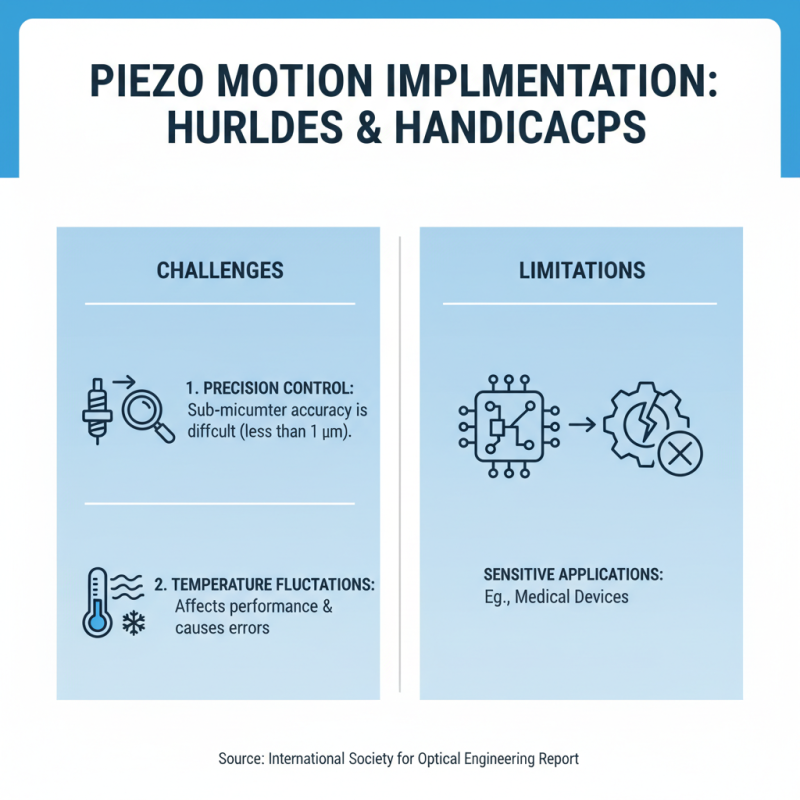
The implementation of piezo motion technologies presents specific challenges. One significant hurdle is the control of precision. According to a report by the International Society for Optical Engineering, achieving less than one micrometer accuracy can be complex. Additionally, temperature fluctuations can affect the performance of piezo systems. This can lead to errors in highly sensitive applications, such as in medical devices.
Another challenge lies in the materials used for piezoelectric components. Not all materials can handle the stress and fatigue over time. The American Ceramic Society highlights that certain piezo materials degrade faster under continuous cycling. This could limit their lifespan in practical applications, thereby raising costs and complicating maintenance procedures.
Lastly, integration within existing systems can be problematic. Many current technologies may not be designed to accommodate piezoelectric devices. This lack of compatibility can lead to higher development costs and extended timelines. Addressing these limitations is crucial for unlocking the full potential of piezo motion technologies in various industries.
Future Trends and Innovations in Piezo Motion Technology
Piezo motion technology is driving significant advancements in precision machinery. This innovative approach offers fine movement control that traditional technologies often struggle to match. Recent reports predict that the piezoelectric actuator market will reach $11.3 billion by 2028, highlighting a growing demand across several industries. Such growth indicates a shift towards highly responsive and compact solutions.
In medical devices, piezo motion is enhancing precision in surgical instruments. For instance, piezoelectric actuators can achieve sub-micrometer movements. This capability is crucial for procedures requiring extreme accuracy. However, challenges remain. The integration of piezo systems into existing setups can be complex and costly. Engineers must address these barriers to fully capitalize on piezo technology's advantages.
Moreover, piezo motion is being explored in robotics. The need for agile, precise movements defines modern robotic applications. However, many prototypes face obstacles like energy efficiency and durability. Research is ongoing to improve performance while reducing environmental impact. As the industry evolves, piezo motion technology will likely transform not only automation but also everyday applications.
Why is Piezo Motion Revolutionizing Precision Technologies? - Future Trends and Innovations in Piezo Motion Technology
| Dimension |
Description |
Impact Level |
Future Trends |
| Motion Control |
High precision motion control in various applications |
High |
Integration with AI for autonomous operation |
| Low Power Consumption |
Enables devices to operate efficiently with lower energy needs |
Medium |
Development of miniaturized devices |
| Material Innovation |
New piezoelectric materials enhancing performance |
High |
Biocompatible materials for medical applications |
| Miniaturization |
Creation of smaller and lighter devices |
Medium |
Advancements in MEMS technology |
| Robustness |
Enhanced durability and reliability in harsh conditions |
High |
Applications in aerospace and automotive sectors |